
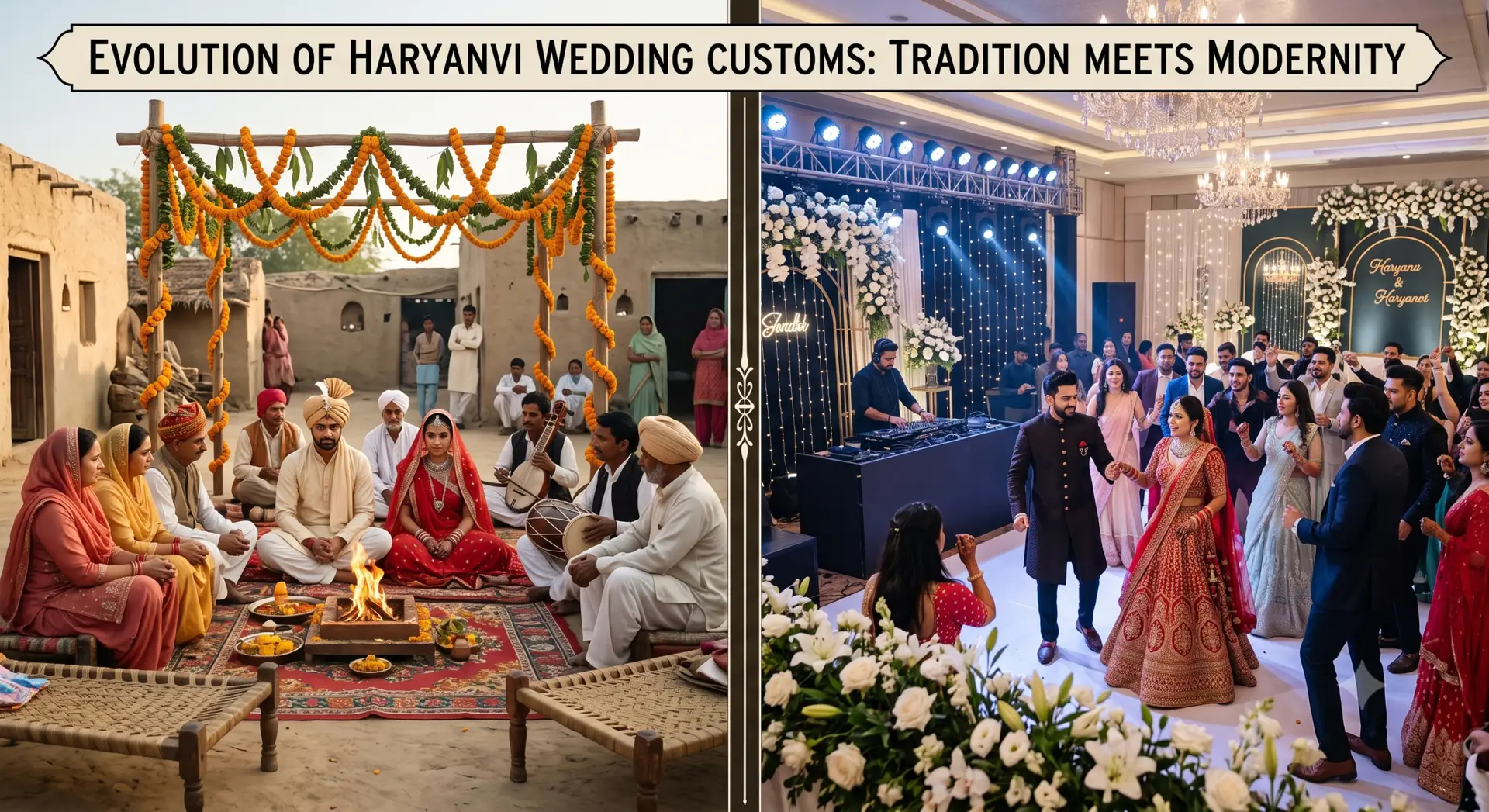
There is something deeply moving about a Haryanvi wedding — the sound of dholak drifting across an open courtyard, the scent of haldi and flowers, elders gathered to offer blessings, and the entire village seemingly part of one family's celebration. For generations, marriage in Haryana was not just a union of two people. It was the coming together of families, communities, and culture.
But spend time with young couples getting married in Haryana today, and you will find a very different picture: designer lehengas, theme-based decorations, professional cinematographers, Sangeet nights, and beautifully lit wedding farms where hundreds of guests are hosted with warmth and organisation.
So how did Haryanvi weddings evolve? And what does this change tell us about Haryana itself?
Where Tradition Meets Modern Celebration: SD Farm Dhand
As you'll read below, one of the biggest shifts in Haryanvi weddings has been the move from the family courtyard to the professionally managed wedding farm. SD Farm Dhand, located on the Dadwana Bypass, Dhand-Kurukshetra Road in Kaithal, is a genuinely Haryanvi answer to this shift — offering the open-air feeling and natural setting families love, along with the parking, lighting, catering, and décor-friendly infrastructure that modern weddings need. It's a space built to let tradition be celebrated at scale, without losing its soul.
What Was a Traditional Haryanvi Marriage Like?
In many Haryanvi families — particularly in village communities and joint families — a wedding was a multi-day, community-driven affair. It was rarely organised by professionals. Instead, it was carried by families, neighbours, and caste-community networks, each contributing in their own way.
Roka and Rishtaa Pakka — the early stages of agreeing to a match — typically involved senior family members and community elders. Trust was placed in families, not agencies.
The Sagai (engagement) was a relatively simple ceremony, often conducted at home, surrounded by close relatives. Far more elaborate were the days of preparation that followed.
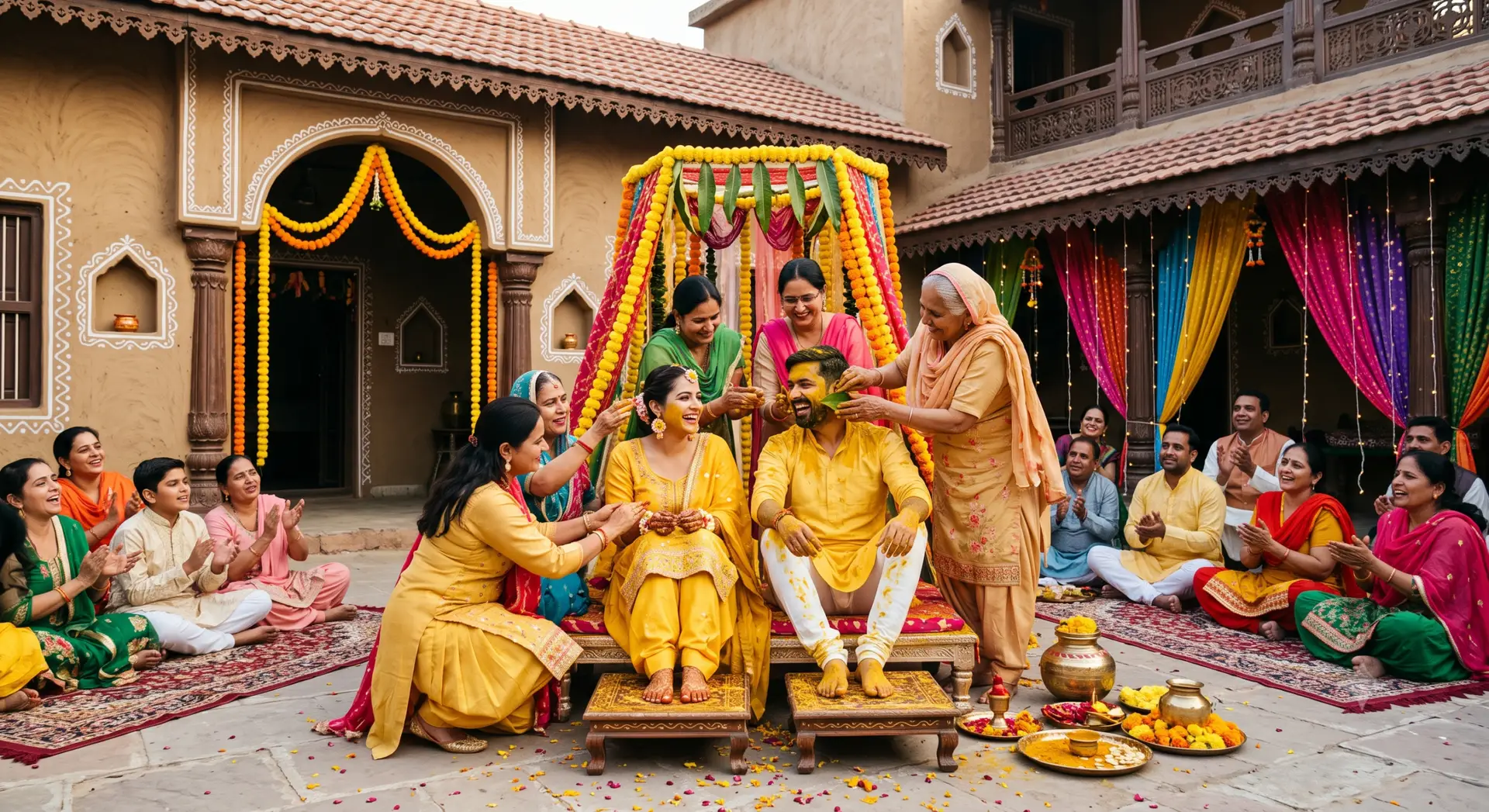
Haldi was applied to the bride and groom separately, with women singing traditional folk songs — often humorous, sometimes bittersweet. Mehndi was applied by women of the household or local mehndi artists, again accompanied by singing and celebration.
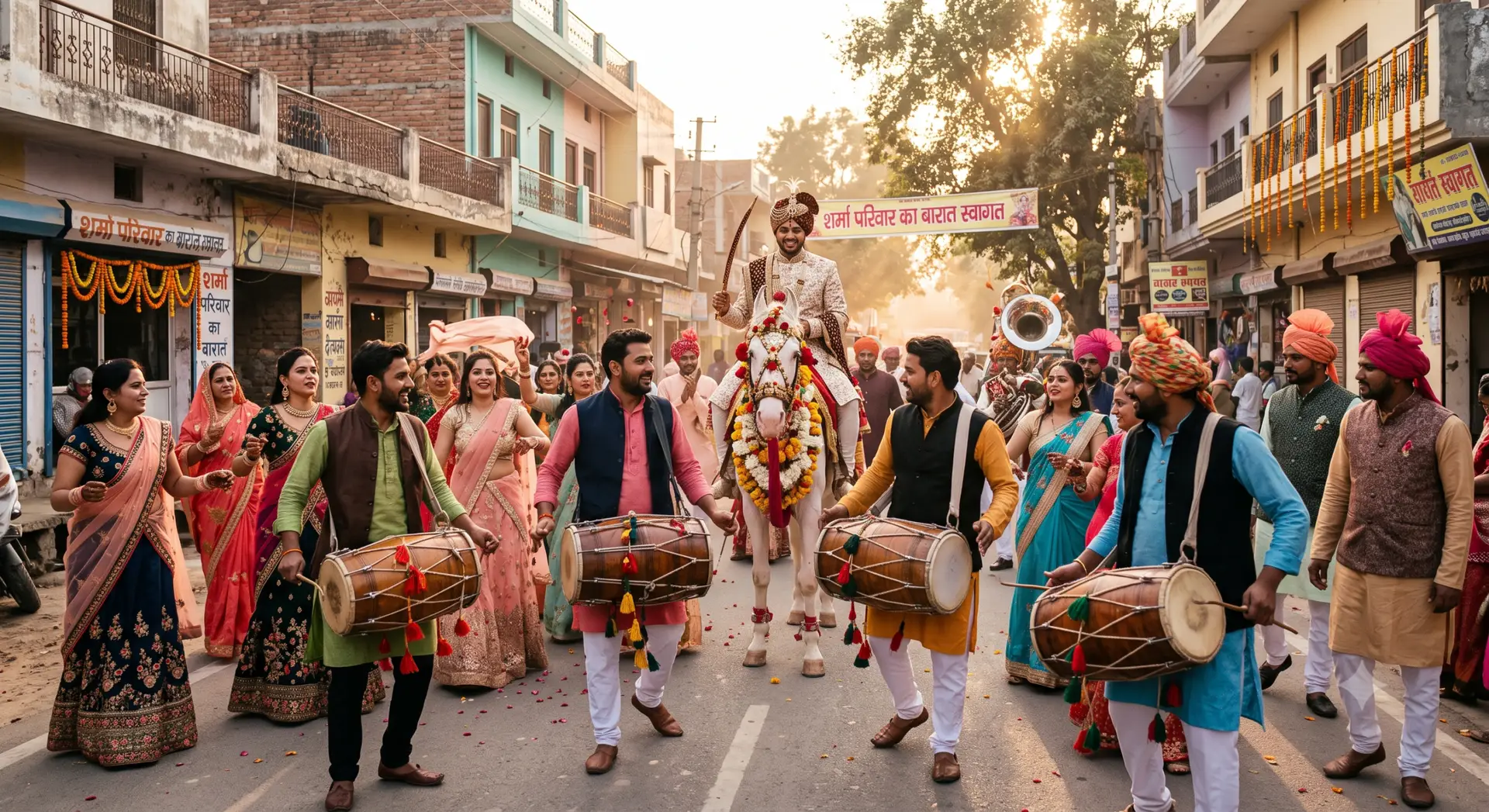
The Baraat — the groom's procession — was a spectacle of its own. Arriving to the sound of the band or dholak players, it brought families together in a moment of collective welcome. The Milni ceremony that followed was an emotional exchange of garlands between the two families, with family members being introduced formally and honoured.
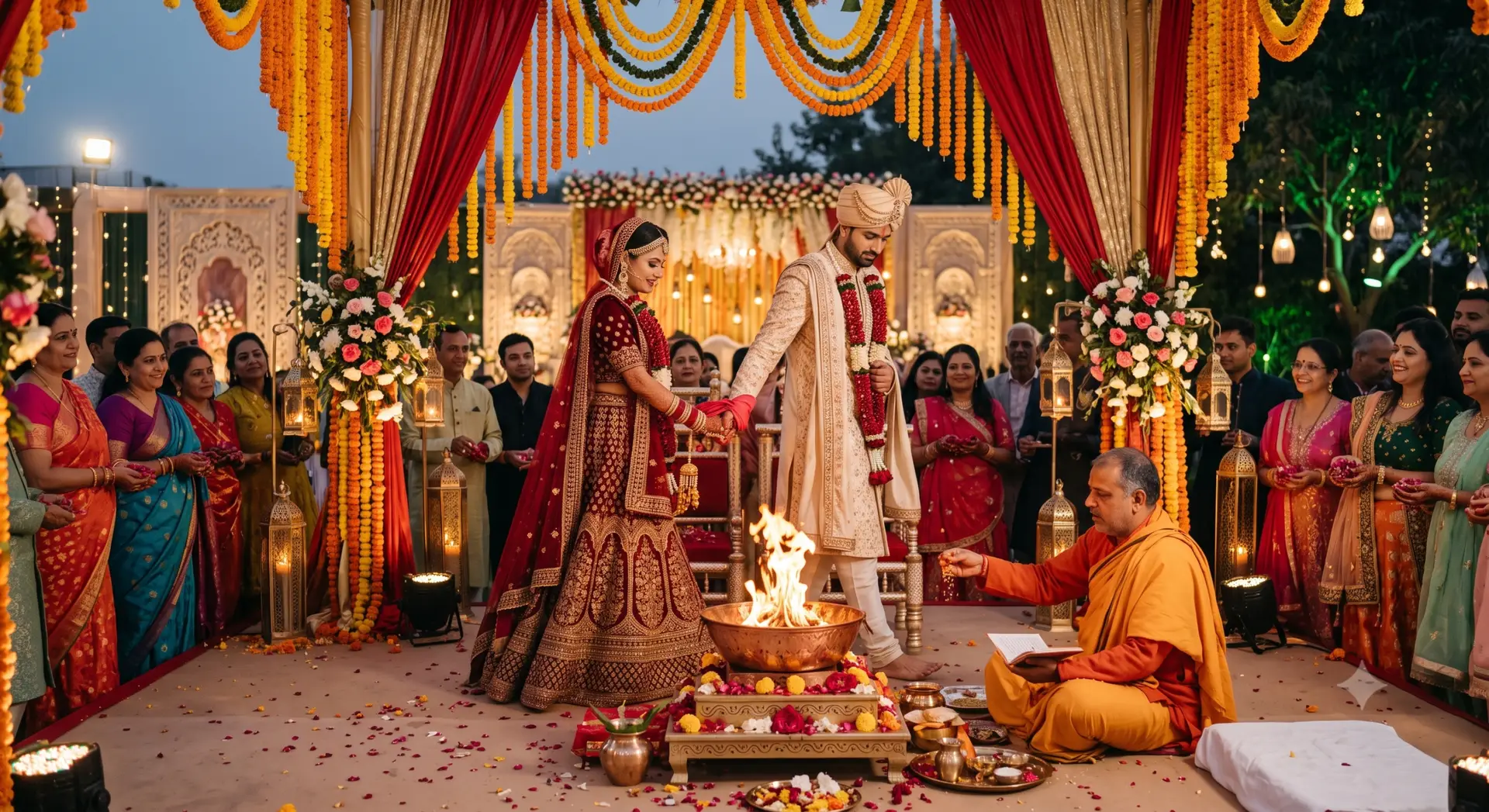
The main wedding rituals — pheras (the seven rounds around the sacred fire), Kanyadaan, and the priest's recitations — took place according to Hindu tradition, with regional customs varying across communities and castes.
Vidaai, the departure of the bride, was — and in many families, still is — one of the most emotionally powerful moments in any Haryanvi wedding.
It is important to note that customs in Haryana have never been uniform. Practices varied significantly between communities, districts, castes, and even individual families. What held true in a village near Hisar may have differed from customs in Gurugram or Kaithal. These variations are part of what makes Haryana's wedding culture so rich and layered.
How Modern Haryanvi Weddings Look Today
Over the past two to three decades, Haryanvi weddings have undergone a remarkable transformation — shaped by urbanisation, rising incomes, education, social media, and an expanding professional wedding industry.
Today, many families begin with a formal engagement ceremony that may itself be a significant event with décor, photography, and a guest list. Wedding planners are increasingly common, coordinating everything from flowers to food to the schedule of rituals.
Pre-wedding shoots — once unheard of — are now a popular tradition in themselves, with couples photographed at scenic locations before the wedding day arrives.
The Sangeet night has become a standard fixture at many Haryanvi weddings — an evening of music, dance performances, and celebration that blends Haryanvi folk songs with Bollywood and Punjabi-pop.
Professional DJs and live bands have largely replaced the traditional band-wallahs at many urban and semi-urban weddings, though the sound of the dholak has not disappeared entirely — often it runs alongside the DJ, bridging generations in a single evening.
Digital invitations via WhatsApp are now sent alongside or instead of printed cards. Some families commission elaborate video invitations. Social media has turned wedding moments into shared experiences for extended networks across cities and countries.
Catering has moved from home-cooked community meals to professional catering services offering extensive menus — with regional dishes sitting alongside Continental and Punjabi cuisines on the buffet table.
Bridal fashion has expanded dramatically. While traditional red and gold attire remains meaningful and beloved, designer lehengas, embroidered sherwanis, and fusion silhouettes are now part of the Haryanvi wedding wardrobe. Bridal makeup artists travel specifically for weddings, and entire teams of stylists are part of the wedding day.
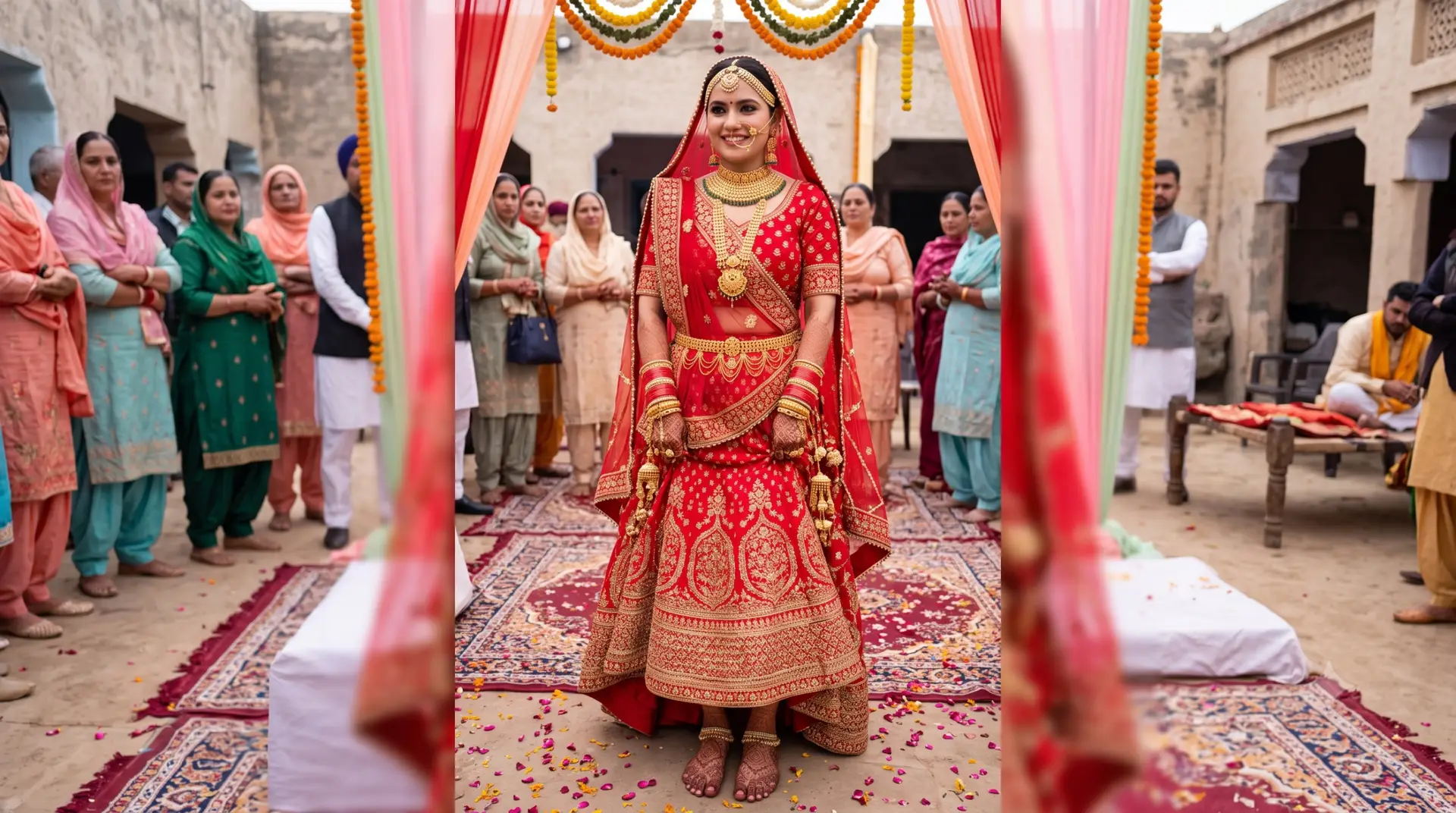
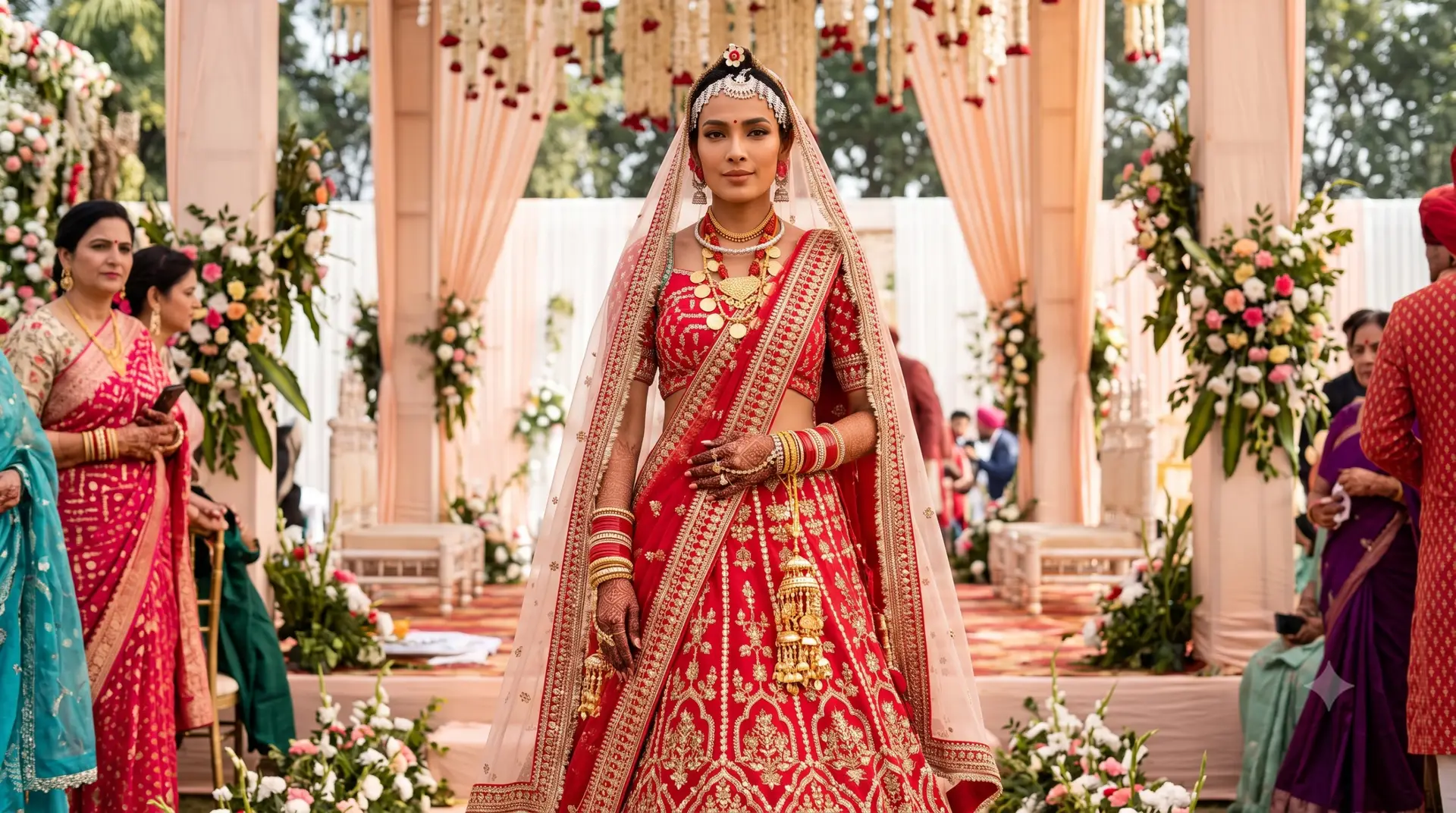
Traditional vs Modern Haryanvi Wedding: Side-by-Side Comparison
| Aspect | Traditional Haryanvi Marriage | Modern Haryanvi Wedding |
|---|---|---|
| Venue | Home, courtyard, community spaces | Banquet halls, wedding farms, hotels & event venues |
| Invitations | Personal visits, printed cards | Printed cards + WhatsApp/digital invitations |
| Décor | Simple, traditional decoration | Themed, professionally designed décor |
| Music | Folk songs, dholak, traditional singing | DJ, live bands, folk + Bollywood/Punjabi music |
| Clothing | Traditional regional attire | Designer lehengas, sherwanis & fusion wear |
| Food | Traditional home or community cooking | Professional catering with diverse menus |
| Photography | Limited or occasional | Professional photography, cinematic video & pre-wedding shoots |
| Family role | Highly family and community driven | Family + professional wedding teams |
| Guest experience | Community-oriented | Personalised and hospitality-focused |
| Technology | Minimal | Digital invitations, social media, online planning |
| Ceremonies | Mostly traditional | Traditional rituals + modern celebrations |
| Wedding duration | Often spread across several days | More structured and professionally scheduled |
What Has Changed the Most?
The single biggest shift in Haryanvi weddings is perhaps the space — and everything that comes with it.
When a wedding moves from an open courtyard to a professionally managed wedding venue, it does not just change the backdrop. It changes the flow of the day, the experience of guests, the scale of celebration, the possibilities for décor, and the role of family members, who are now guests rather than organisers.
Urbanisation has brought nuclear families and reduced the availability of the extended community labour that once made home weddings possible. Education and careers have changed timelines — many couples get married in their mid-to-late twenties, with their own sense of what their wedding should feel like. Women's changing roles have brought brides from passive participants to active decision-makers in their wedding planning. Rising incomes and consumer culture have expanded both expectations and possibilities.
Social media has had a profound effect — young couples in Haryana are influenced not only by what they see in their own communities but by weddings shared across Instagram and YouTube from across the country.
None of this means traditional weddings were inferior. In many ways, they carried a depth of community participation that modern weddings cannot always replicate.
Traditions That Are Still Strong
Despite all the change, certain customs in Haryanvi weddings have shown remarkable resilience.
In most families — urban, semi-urban, and rural — Haldi, Mehndi, Baraat, Milni, Pheras, Kanyadaan, and Vidaai continue to hold their place. The emotional weight of these rituals has not diminished. If anything, modern production has made them more visible and more beautifully documented.
The culture of family blessings — touching the feet of elders, seeking the dua of grandparents — remains deeply embedded. Respect for elders continues to shape how weddings are conducted, even when the venue is a five-star banquet hall.
Traditional Haryanvi food — from dal-baati to churma, from ghee-laden sweets to homestyle kheer — continues to appear on modern wedding menus, often presented alongside contemporary dishes. Folk music, too, has not disappeared. Many modern weddings specifically include a set of traditional folk songs by local artists, recognising that these songs carry stories no DJ track can replace.
Practices vary significantly between families. What one family considers essential, another may adapt or simplify — and both are valid expressions of a living culture.
From Courtyard to Wedding Venue: The Changing Wedding Space
Perhaps the most visible evolution in Haryanvi weddings is where they now take place.
For much of Haryana's history, the family home or community open space — the aangan — was the natural venue for a wedding. Tents went up in the fields, neighbours contributed their utensils and time, and the entire neighbourhood became part of the event.
As families moved to towns and cities, the home venue became impractical. Marriage halls came next — large covered spaces that could host hundreds of guests in a single locality. But as weddings grew in scale and expectation, marriage halls gave way to banquet halls and then to something newer: the wedding farm.
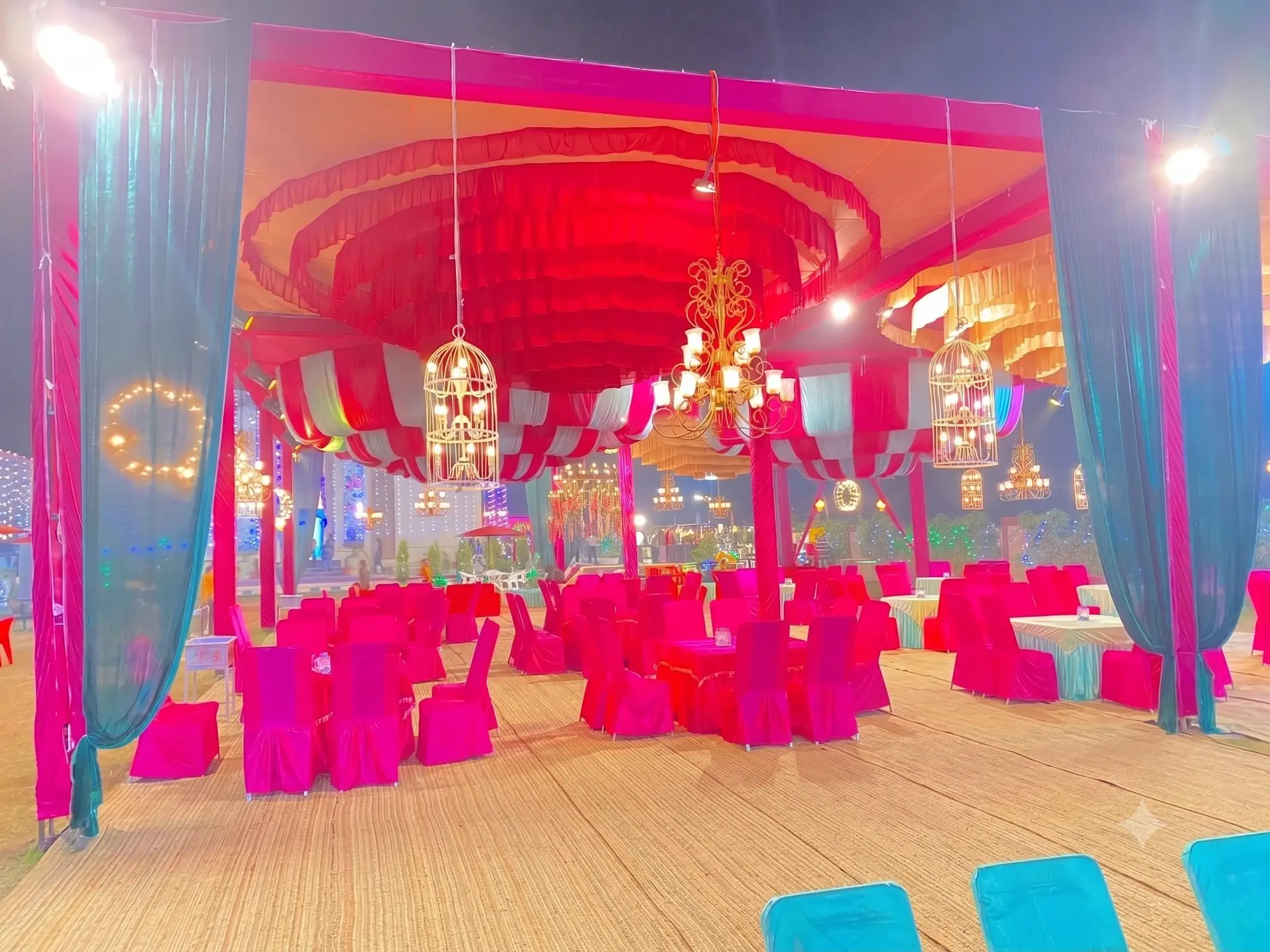
Wedding farms and event venues — like SD Farm Dhand, situated on the Dhand–Kurukshetra Road in Kaithal — have emerged as a genuinely Haryanvi answer to this need. They offer the open-air feeling and natural setting that families appreciate, combined with the professional infrastructure that modern weddings require: parking, weather-appropriate spaces, lighting, catering facilities, and décor-friendly environments.
Families choosing these venues are not abandoning tradition. They are finding spaces where tradition can be celebrated at scale — where the pheras can take place beneath open skies, where the baraat has room to arrive in style, and where grandparents and guests alike are comfortable.
Are Modern Weddings Losing Haryanvi Culture?
This is a question many families ask — and the honest answer is: not necessarily.
Culture does not have to reside only in discomfort or in the absence of convenience. A traditional Kanyadaan performed in a beautifully decorated outdoor venue, with a pundit reciting the correct mantras, surrounded by three generations of family — that is a deeply cultural moment, regardless of where it takes place.
What matters is intention. Families who choose to include Haryanvi folk songs alongside their DJ set, who serve regional dishes alongside the buffet, who ensure elders lead the rituals, who keep Vidaai as a sacred moment rather than a rushed photo opportunity — these families are keeping culture alive.
The risk is real but manageable. When weddings are planned primarily for social media rather than for the family, when rituals become photo props rather than meaningful moments, something is indeed lost. But when the planning starts with culture and is simply supported by modern infrastructure, the result can be a wedding that is both beautiful and authentic.
Traditional vs Modern Weddings: Pros and Challenges
Traditional weddings carried the strength of community — neighbours shared the work, elders led the ceremonies, and the event was genuinely collective. The cost was often lower because community contribution replaced professional services. But they required significant logistical effort from families, were weather-dependent, and could be difficult to scale as guest lists grew.
Modern weddings offer organisation, comfort, and the ability to celebrate at a scale traditional spaces could not support. They allow for personalisation and tend to be more manageable for nuclear families without extended community networks. The trade-off is often cost — and the risk that, without conscious planning, cultural elements may fade to the background.
Neither approach is inherently superior. Many of the most memorable Haryanvi weddings today are those that have found a thoughtful balance between the two.
How to Preserve Haryanvi Culture in a Modern Wedding
- Commission a set of traditional folk songs, performed live by local artists during the Mehndi or Sangeet.
- Include regional dishes — churma, kheer, dal-baati, or family recipes — alongside the catered menu.
- Involve elders in rituals; let grandparents and senior family members lead customs where possible.
- Use Haryanvi language in selected moments of the ceremony — a blessing, a folk song, a family custom.
- Incorporate traditional décor elements — brass vessels, marigolds, traditional textiles — within modern venue décor.
- Document family customs; ask elders to share their wedding memories and stories as part of pre-wedding events.
- Let the pheras be unhurried — the heart of the wedding deserves time, not just a time slot.
- Choose venues that accommodate outdoor rituals — open-air settings that allow the baraat, the pheras, and the Vidaai to happen in a natural, dignified space.
The Future of Haryanvi Weddings
Haryanvi weddings in the next decade will likely continue to evolve — shaped by technology, changing family structures, and the preferences of a generation that has grown up with both tradition and the internet.
Live-streaming weddings for family members abroad is already becoming common. Sustainable weddings — reducing single-use décor and food waste — are a growing conversation. Personalised ceremonies, where couples design their own elements alongside traditional rituals, are on the rise.
But through all of this, the emotional foundation of the Haryanvi wedding — the baraat's arrival, the Milni, the pheras around the fire, the Vidaai — is unlikely to disappear. These are not merely customs. They are the language through which Haryanvi families express love, belonging, and continuity.
The future of Haryanvi weddings, at its best, will be one where heritage and modernity are not in conflict, but in conversation.
Conclusion
Haryanvi weddings have changed in their setting, their scale, their style, and their production. But they have not changed in their soul.
Families in Haryana continue to bring their best — their warmth, their generosity, their devotion to ritual, and their love of celebration — to every wedding, whether it takes place in an open courtyard or a professionally managed wedding venue.
The traditions that matter most have proven remarkably resilient. And as more families discover spaces that honour both the culture of Haryana and the comfort of a well-organised celebration, the Haryanvi wedding is not diminishing — it is finding new ways to shine.
If you are planning a wedding in Haryana and looking for a venue that understands the balance between tradition and modern celebration, explore SD Farm Dhand in Kaithal — a wedding farm designed to give your celebration the space, the setting, and the infrastructure to bring your vision to life.
Frequently Asked Questions
In many Haryanvi families, key rituals include Haldi, Mehndi, Sagai, Baraat, Milni, the pheras (seven rounds around the sacred fire), Kanyadaan, and Vidaai. Practices vary between communities, districts, and families.
Modern Haryanvi weddings increasingly feature professional wedding planners, banquet halls and wedding farms, Sangeet nights, pre-wedding shoots, digital invitations, and designer attire, while still preserving core traditional rituals.
Yes. In most families, core customs such as Haldi, Baraat, Milni, pheras, and Vidaai continue to be observed. Modern weddings typically blend these traditions with contemporary celebrations and venues.
Marriage halls are typically indoor covered spaces in towns and cities. Wedding farms are larger outdoor venues that offer open-air settings, gardens, and professional infrastructure, suitable for bigger guest lists and elaborate celebrations.
By including traditional folk music, serving regional dishes, involving elders in rituals, using traditional décor elements, speaking Haryanvi during selected ceremonies, and choosing venues that allow for outdoor rituals.
Yes — wedding farms offer the open-air setting, space, and cultural flexibility that allows both traditional rituals and modern celebrations to coexist comfortably. They are particularly well-suited for large gatherings, such as at SD Farm Dhand in Kaithal.
Plan a Wedding That Honours Both Heritage and Comfort
SD Farm Dhand gives your family the open-air space, the infrastructure, and the flexibility to celebrate every Haryanvi tradition — exactly the way you envision it.
📍 Dadwana Bypass, Dhand-Kurukshetra Road, VPO Dhand, District Kaithal, Haryana 136021
Explore More About SD Farm Dhand
- About Us — Our story since 2020
- Why Choose Us — What sets our venue apart
- Gallery — Real weddings, real celebrations
- Reach Us — Directions and contact details